
How to cash up a till: an end-of-day guide for UK takeaways and cafés
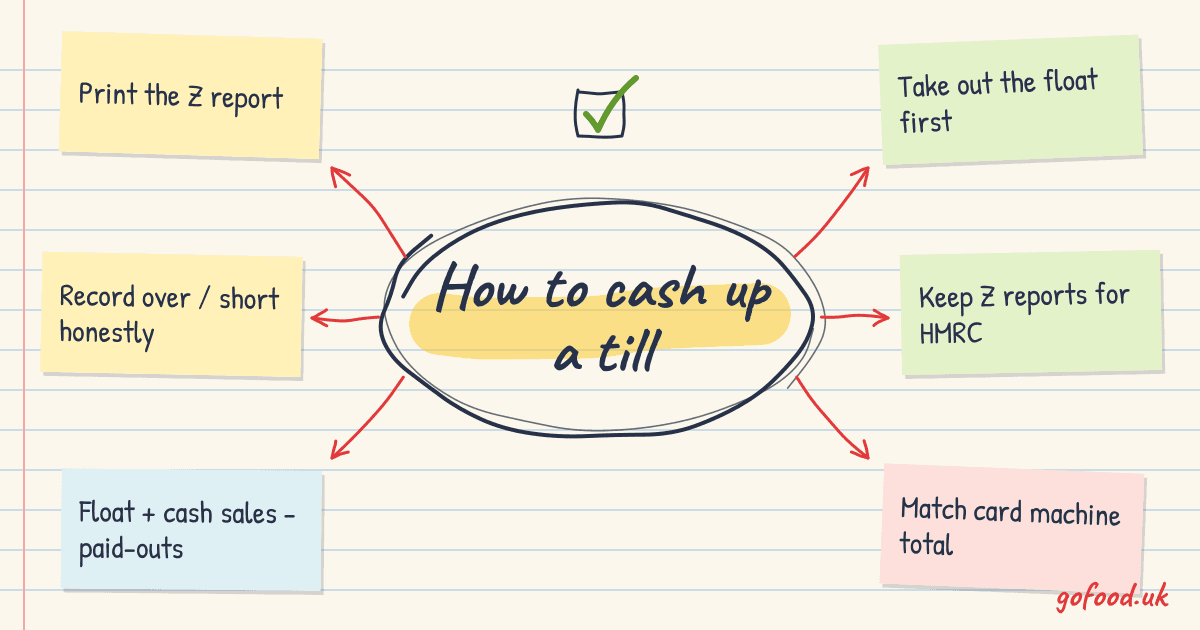
Cashing up a till means counting what is in the drawer at the end of the day and checking it against what the till says you should have. You take out the float, count the cash, match the card total against your card machine, and write down any difference. Done every night, it takes 10 to 15 minutes and catches mistakes while everyone still remembers the shift.
This guide walks through how to cash up a till step by step, with a worked example, a simple cash-up sheet, and what HMRC expects you to keep. It is written for UK takeaways, cafés and small restaurants, but the steps are the same for most small shops.
The short answer
To cash up a till at the end of the day:
- Stop taking orders on that till and print the end-of-day (Z) report.
- Count the cash in the drawer, note by note and coin by coin.
- Take out the float for tomorrow and set it aside.
- Work out the expected cash: float + cash sales − cash paid out.
- Compare the counted cash with the expected cash and record any over or short.
- Run the end-of-day report on your card machine and match it to the till's card total.
- Bag the takings, fill in the cash-up sheet, and lock both away.
Why cashing up every day matters
A daily cash-up is the simplest check you have on your takings. It shows wrong change, missed orders, refunds done on the wrong button, and money that has gone missing. If you leave it a week, a £20 gap is very hard to explain. If you check every night, you usually know which order caused it.
It also gives you a clean record of daily takings. HMRC lists till rolls among the proof of income you should keep, and VAT-registered businesses need a record of daily takings (more on this below).
Before you start: what you need
- The till's end-of-day report (often called a Z report or Z read). An X report shows the totals so far without closing the day. A Z report closes the day and resets the totals for tomorrow.
- The card machine's end-of-day or totals report.
- Any paid-out slips (for example, cash taken out to buy milk or pay a delivery).
- A cash-up sheet (paper or in your EPOS).
- Bank bags and somewhere safe to keep them.
Try to cash up away from the counter, with the door locked, and ideally with two people for the count.
How to cash up a till, step by step
1. Close the till and print the Z report
Finish the last order, then stop using that till. Print or open the end-of-day report. Check it shows cash sales, card sales, refunds, voids and any cash paid in or out. If you have more than one till, cash up each one on its own.
2. Count the cash
Count each type of note and coin separately and write the totals down. Count notes twice. A coin scale or counting tray saves time on busy nights, but a careful hand count is fine.
3. Take out the float
The float is the change you start the day with, for example £150 in small notes and coins. Count it out and put it to one side, ready for tomorrow. Keep the float the same every day, so the sums are easy.
4. Work out the expected cash
Expected cash in the drawer = opening float + cash sales − cash refunds − cash paid out + cash paid in.
Most EPOS systems do this sum for you. On an old cash register, you do it by hand from the Z report.
5. Compare and record the difference
Counted cash minus expected cash gives you the variance. A small amount over or short now and then is normal. The same till being short every week is not, and is worth looking into.
6. Match the card total
Run the end-of-day or totals report on your card machine. Some card machines settle on their own each night; others need you to close the day. Check the machine's card total matches the card sales on your till. If it does not, look for a card payment rung up as cash, or an order taken on the card machine but never put through the till.
Do the same for online orders: they are paid before they reach you, so they should be counted separately from cash and in-store card.
7. Bag up and record
Put the takings (counted cash minus the float) in a bank bag with the Z report and the cash-up sheet. Lock it in a safe until it goes to the bank. Keep the float in a separate bag.
A worked example
Here is one night at a takeaway with one till and a £150 float.
| Line | Amount |
|---|---|
| Opening float | £150.00 |
| Cash sales (from Z report) | £642.50 |
| Cash paid out (milk and bags) | −£12.00 |
| Expected cash in drawer | £780.50 |
| Counted cash | £777.30 |
| Variance | £3.20 short |
| Float kept back for tomorrow | £150.00 |
| Cash takings to bank | £627.30 |
| Card sales on till | £1,184.20 |
| Card machine end-of-day total | £1,184.20 |
| Card difference | £0.00 |
The card side matches. The cash is £3.20 short, which is likely wrong change on one order. Write it on the sheet with a note, and bank £627.30, which is what is really there. Don't top up the drawer from your own pocket to make it balance; that hides the problem.
A simple cash-up sheet
Whether on paper or on screen, your daily cash-up sheet should record:
- Date, till number and who counted
- Opening float
- Cash sales, card sales and online sales from the Z report
- Refunds and voids
- Cash paid in and paid out, with reasons
- Counted cash, by notes and coins
- Expected cash and the variance
- Card machine total and any card difference
- Amount bagged for the bank and bag number
- Signature (two if two people counted)
What HMRC expects you to keep
For sole traders and partners, gov.uk lists "sales invoices, till rolls and bank slips" among the types of proof to keep, and says records must be kept for at least 5 years after the 31 January deadline for that tax year. Limited companies must keep records for 6 years from the end of the financial year they relate to.
If you are VAT-registered, HMRC's VAT Notice 700/21 lists "records of daily takings such as till rolls" as business records, and says VAT records should generally be kept for at least 6 years. If you use a VAT retail scheme, you must keep a digital record of your daily gross takings. The notice says till rolls and Z readings themselves still need to be kept, but they don't have to be digital.
A daily cash-up with saved Z reports covers most of this. If your EPOS keeps the reports for you and lets you download them, keep a copy as well, in case you ever change system. For how VAT works on hot and cold takeaway food, see our guide to VAT on takeaway food. Your accountant can confirm what applies to your business.
Common cash-up mistakes
- Counting the float as takings. Always take it out first.
- Not recording paid-outs. Cash for milk or a delivery driver's fuel must have a slip, or it looks like a shortage.
- Cashing up several tills together. You lose track of where a gap came from.
- Card payments rung up as cash (or the other way round). Cash is short and card is over by the same amount.
- Skipping nights when it's busy. That's when mistakes happen most.
- Topping up the drawer to make it balance. It hides theft and errors.
What helps: till and hardware
A modern EPOS makes cashing up quicker because it works out the expected cash for you, records paid-ins and paid-outs, and keeps every report. A cash drawer that opens only from the till also helps, because staff cannot open it without a sale or a logged reason. You can see cash drawers from about £24 ex VAT and receipt printers from about £69 ex VAT in our shop (prices as of November 2026).
Where GofoodPOS fits
The GofoodPOS EPOS is a till for Android tablets and Windows. Till staff sign in with a PIN, and it records the cash float, cash in and out, and an end-of-shift count against the expected cash. Its reports include cash-ups for each till, with float, cash and card sales, cash in and out, and the counted cash against what was expected. You also get an end-of-day email minutes after you close, and reports for any date range with a spreadsheet download.
Card payments at the till are recorded from your own card machine, so you still run your card machine's end-of-day report and match the totals. Online orders cost £0 commission and are paid into your own Stripe account, so they show up separately from till cash. Setup and support are in English and Chinese. See pricing for plans.
In short
- Cash up every till, every night, on its own.
- Expected cash = float + cash sales − refunds − paid-outs + paid-ins.
- Take out the float, count the rest, and record any variance honestly.
- Match the till's card total with your card machine's end-of-day report.
- Keep Z reports, till rolls and cash-up sheets: at least 5 years after the filing deadline for sole traders, and 6 years for companies and VAT records.
Want help setting up a till that does the cash-up sums for you? Get in touch and we'll talk you through it, in English or Chinese.