
Making Tax Digital for takeaways: what UK sole traders need to do
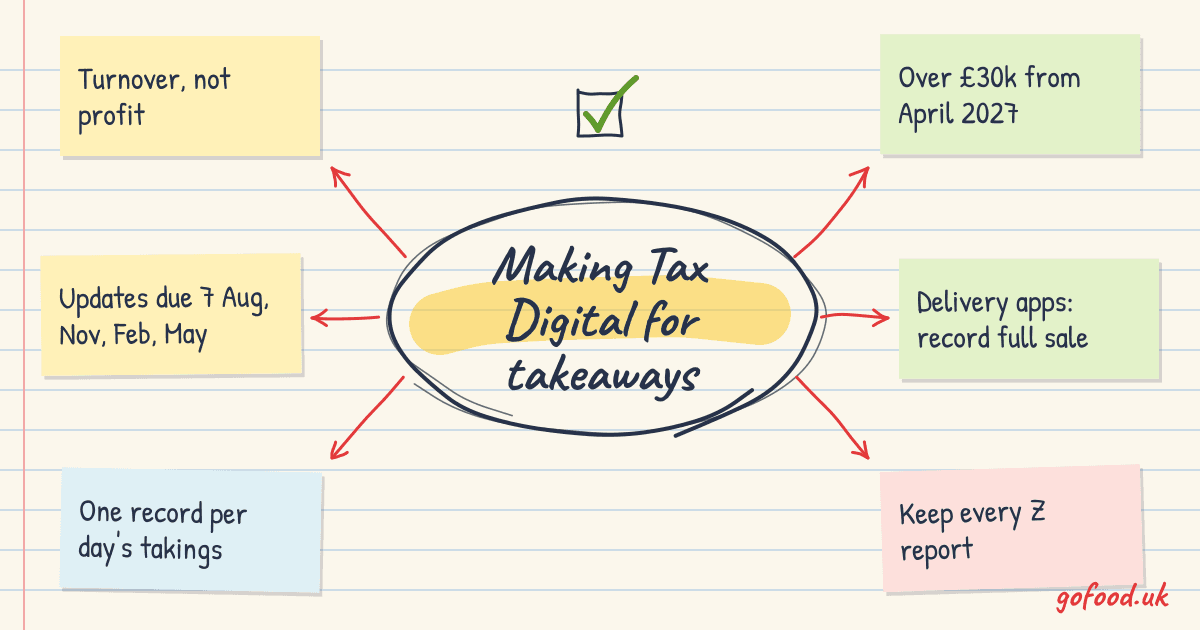
If you run a takeaway, café or small restaurant as a sole trader, Making Tax Digital (MTD) for Income Tax probably applies to you, now or soon. Since 6 April 2026 it has applied to sole traders with turnover over £50,000. From 6 April 2027 it will apply to those over £30,000, and from April 2028 to those over £20,000.
In practice it means three things: keep your takings and costs as digital records, send HMRC a short summary every three months through recognised software, and file your tax return through that software by 31 January. Your till already holds most of the numbers you need. This guide explains what Making Tax Digital means for a takeaway, the dates to know, and how to use your EPOS reports so the quarterly updates take minutes, not a weekend.
The short answer
Making Tax Digital for takeaways works like this:
- Check if you are in. It covers sole traders (and landlords). The test is your turnover before expenses, not your profit.
- Pick MTD software. It must be on HMRC's list of compatible software. Bookkeeping apps and "bridging" software for spreadsheets both count.
- Keep digital records. Shops and takeaways can record one total for each day's takings, instead of every single sale.
- Send quarterly updates. Every three months your software adds up the totals and sends them to HMRC. Deadlines are 7 August, 7 November, 7 February and 7 May.
- File your tax return through the software by 31 January after the tax year ends.
Your EPOS end-of-day report (the Z report) gives you the daily takings figure. Keep it every day and the rest is much easier.
Does Making Tax Digital apply to my takeaway?
You need to use MTD for Income Tax if you are a sole trader or landlord registered for Self Assessment, and your "qualifying income" is over the threshold for the tax year HMRC looks at.
| Your turnover was over… | In tax year | You must use MTD from |
|---|---|---|
| £50,000 | 2024 to 2025 | 6 April 2026 |
| £30,000 | 2025 to 2026 | 6 April 2027 |
| £20,000 | 2026 to 2027 | 6 April 2028 |
Source: GOV.UK, check if you need to use Making Tax Digital for Income Tax.
A few points that catch takeaway owners out:
- It is turnover, not profit. HMRC says qualifying income is your gross income from self-employment and property before expenses. A takeaway taking £600 a week turns over about £31,200 a year, so it is over £30,000 even if the profit is small.
- Self-employment and rental income are added together. If you also let out a flat, that rent counts towards the same threshold.
- Limited companies are not in MTD for Income Tax. It is for sole traders and landlords. Partnerships will join later, on a date HMRC has not yet set.
- A letter is not required. HMRC writes to people it thinks are in scope, but if you are over the line and get no letter, it is still your job to sign up.
A quick worked example
Mei runs a Chinese takeaway as a sole trader. Her till shows average takings of £1,500 a week. Over 52 weeks that is £78,000 turnover. She was over £50,000 in 2024 to 2025, so she should have started MTD on 6 April 2026. Her second quarterly update, covering 6 April to 5 October, is due on 7 November 2026.
Her friend runs a small café taking £700 a week, about £36,400 a year. He will need MTD from 6 April 2027, based on his 2025 to 2026 turnover.
What "digital records" mean for a takeaway
MTD asks you to keep digital records of your business income and expenses. For a takeaway that sounds like a lot of work, because you might make 100 sales on a Friday night. The good news is that HMRC has a rule for retailers.
One record for each day's takings
Under HMRC's digital record-keeping direction, a retailer can keep a single digital record of the daily gross takings instead of recording every sale. That daily figure must include:
- cash, card and other electronic payments from customers
- vouchers and other non-cash payments
- sales made through third-party online platforms
You leave out things like void transactions, refunds, training-till sales and float differences.
This is exactly what your till's end-of-day Z report gives you. Each night, enter one line: the date and the total takings. If you also split it into cash and card, it is easier to match your bank later.
Delivery apps: record the full sale
If you sell through a delivery app, the daily takings should include the full value of those sales, not just the amount paid into your bank after commission. The commission is a business expense. Ask your accountant how they want you to record it, but don't simply enter the net payout as your sales.
Expenses
Expenses need digital records too: food and packaging, rent, utilities, wages, card fees, delivery app commission and so on. Most bookkeeping apps let you link your business bank account and pull these in, then you tag each one. Keep paper receipts as well, as you always have.
If you are under the VAT threshold
If your turnover is below the VAT registration threshold (£90,000), HMRC lets you keep simpler records: you can just label each record as "income" or "expense" rather than using the detailed categories. That makes things much lighter for a small café or a new takeaway.
Quarterly update deadlines
Each quarterly update is a summary, not a tax return. Your software adds up your records and sends the totals. Each one covers the tax year so far.
| Update covers | Deadline |
|---|---|
| 6 April to 5 July | 7 August |
| 6 April to 5 October | 7 November |
| 6 April to 5 January | 7 February |
| 6 April to 5 April | 7 May |
Source: GOV.UK, send quarterly updates.
You must send an update even if you had no income in that period, for example if you closed for refurbishment.
What if I'm late?
For the 2026 to 2027 tax year, HMRC will not give penalty points for late quarterly updates. From 2027 to 2028, each late update earns a point, and at 4 points you get a £200 penalty. Late tax returns still get penalty points now. So use this first year to get into the habit.
How your EPOS helps with Making Tax Digital
Your till is not MTD software, but it is where your sales numbers start. A good EPOS makes the quarterly job quick.
Checklist: what to get from your till
- A Z report or end-of-day total every trading day, with no gaps
- Cash and card split, so you can match card takings to your bank
- Sales by channel: counter, phone, your own website, delivery apps
- Refunds and voids shown separately, so they are left out of takings
- VAT worked out per item, if you are VAT registered (see our guide to VAT on takeaway food)
- A report for any date range you can download as a spreadsheet
- A daily cash-up record, so cash takings are counted, not guessed (see how to cash up a till)
A simple weekly routine
- Each night, cash up and keep the Z report.
- Once a week, enter the seven daily totals into your MTD software (or a spreadsheet linked by bridging software).
- Check your bank feed and tag the week's expenses.
- At each quarter end, download the till's report for the period and check it matches what you entered.
- Press send in your software, or pass it to your accountant.
Ten minutes a week beats a full weekend every quarter.
If your till can't give you this
Old cash registers that only print a paper tally, or tills with no date-range reports, make MTD harder. You end up typing totals from paper rolls. If you are replacing your till anyway, check the reports before you buy. Our EPOS bundles come with the till, printer and cash drawer together.
Where GofoodPOS fits
GofoodPOS is an EPOS and online ordering system for UK takeaways. It does not send anything to HMRC, so you still need MTD software or an accountant for that. What it does is give you clean numbers to put in.
The reports show card and cash, delivery and collection, for any date range, with a spreadsheet download. You get an end-of-day email a few minutes after you close. Cash-ups for each till record the float, cash and card sales, cash in and out, and the counted cash against what was expected. VAT is worked out per dish and shown on receipts.
Online orders from your own website carry £0 commission and are paid into your own Stripe account, so there is no app commission to untangle. Card payments at the till are taken on your own card machine and recorded in GofoodPOS. Setup and support are in English and Chinese. For plans, see pricing.
In short
- MTD for Income Tax covers sole traders over £50,000 now, over £30,000 from April 2027 and over £20,000 from April 2028.
- The test is turnover before expenses, not profit.
- A takeaway can record one total for each day's takings: your Z report.
- Include delivery app sales at full value and record commission as an expense.
- Quarterly deadlines are 7 August, 7 November, 7 February and 7 May.
- No penalty points for late quarterly updates in 2026 to 2027, but they start after that.
- Choose software from HMRC's list, and make sure your till gives you daily totals and date-range reports.
This guide is general information, not tax advice. Check your own position with HMRC's online tool or your accountant. If you'd like help choosing a till that makes record keeping easier, get in touch. We can talk it through in English or Chinese.